Vexilar FL-8se Genz Pack (19° Ice-Ducer)
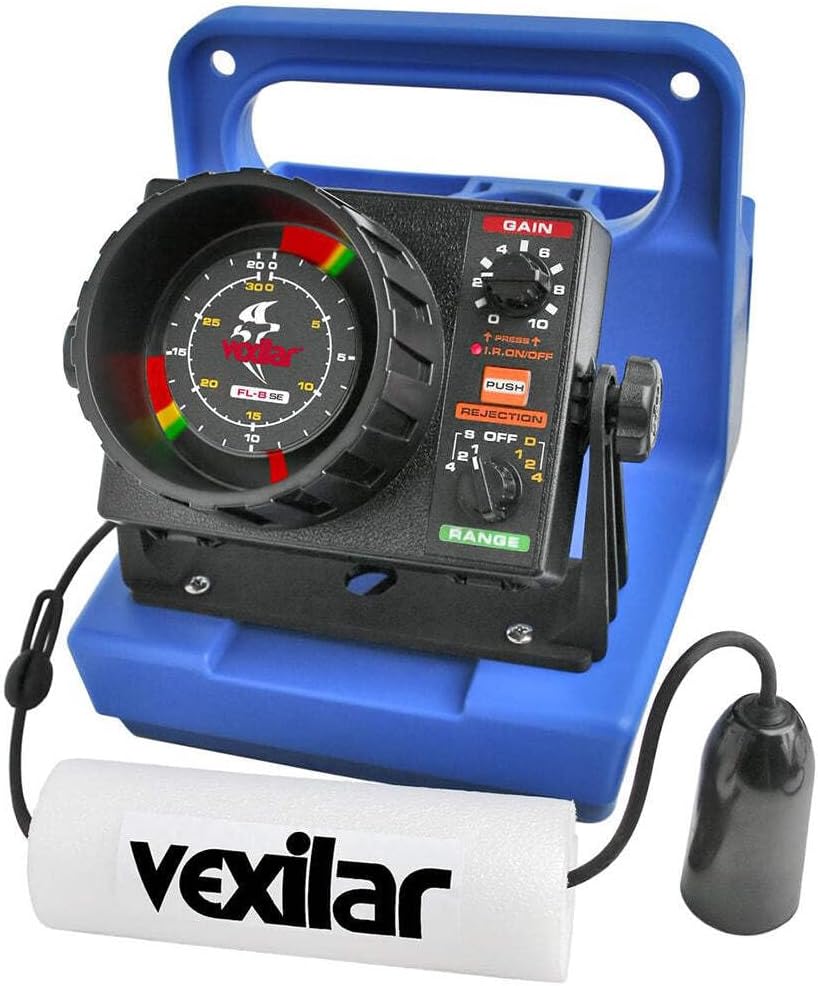
ASIN B002SW68V8Vexilar FL-8se Genz Pack (19° Ice-Ducer) is the #1 pick here, on 4.6-star Amazon buyer ratings (144 of them) and one clear job: a wide 19° cone for shallow water.
Check Price
Six dial flashers from Vexilar, MarCum and Humminbird, each listed with the cone angle and battery its own maker publishes, and a plain note wherever a maker publishes nothing.
Start where the beginner ice guide does: your first winter does not need a flasher. A rod, a hand auger and a few jigs catch plenty of panfish, and several hundred dollars of sonar is a lot to spend before you know you like sitting on a bucket in January. Buy the basics, go a few times, and come back here.
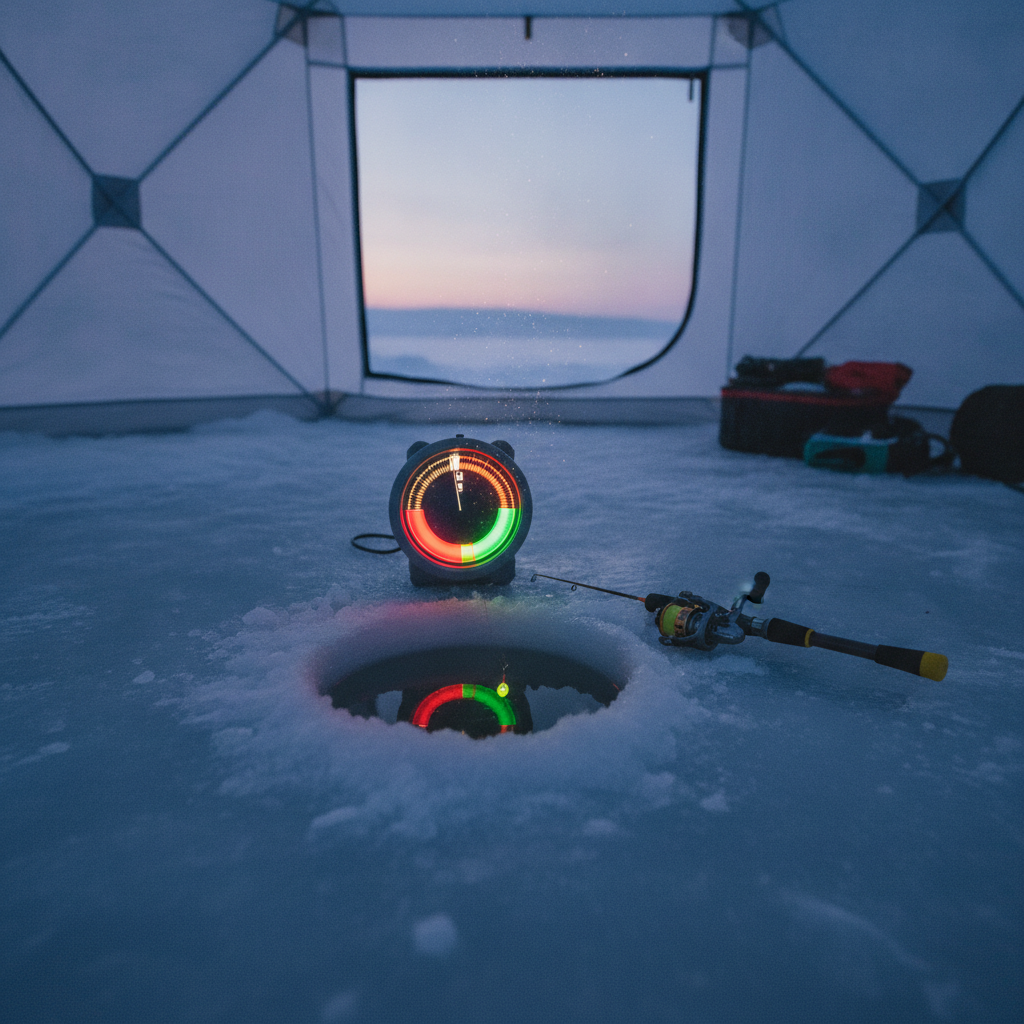
When you do, a flasher is the tool that most changes how you watch your jig through the ice. It is a sonar unit with a round dial: the bottom shows as a band of light, your jig shows as a thin line above it, and a fish shows up as a mark rising toward the jig. You stop guessing whether anything is down there and start watching how fish react to what you do. That feedback is the whole reason to own one.
Most buying guides rank these by power output and stop. The two numbers that decide whether a flasher suits your water are the transducer cone angle and the battery, and both come from the maker. Every pick below lists the cone and battery its own manufacturer publishes, checked in October 2026, and where a maker does not publish a figure this page says so instead of filling the gap. Tom has not used these units on the ice. The picks are ranked from those published specs, Amazon buyer ratings and AI-assisted research. The FLX-38 has only nine Amazon ratings so far, so its 5.0 average says very little yet.

A flasher pack is the head unit, a transducer, a battery, a charger and a case. These are the pieces worth checking before your first day out.
The ice transducer hangs in the hole on a float and stopper so it sits level just under the surface. If it tilts, the cone points off to the side and the bottom reading goes vague.
Vexilar and MarCum both build around a 12 volt battery. Charge it the night before and again after every trip, which is the one battery habit MarCum's manual puts in capital letters.
Lead-acid and lithium batteries charge differently. Use the charger the pack shipped with, or one rated for the same chemistry.
Some packs ship with one and some do not. A padded cover keeps snow off the dial and keeps the transducer cable from getting crushed in a sled.
Slush and ice chips in the hole can sit in front of the transducer. Clear them before you drop it.
Some cases have mounting points for one. It lets you watch the dial and the rod tip together, which is most of the point.
Every row below comes from the manufacturer's own spec page or manual, checked on 2026-10-16. Where a maker does not publish a figure, the row says so. Amazon listings for these units are thin and in one case contradict the maker, so they were not used for any number here.
Vexilar's page lists 200 kHz, 400 watts peak-to-peak, 10 interference rejection steps, six depth ranges from 20 to 120 feet and 1 inch target ID. Every Genz Pack ships with a 12 volt, 9 amp-hour battery and charger. Battery chemistry is not stated on this page. No run time is published.
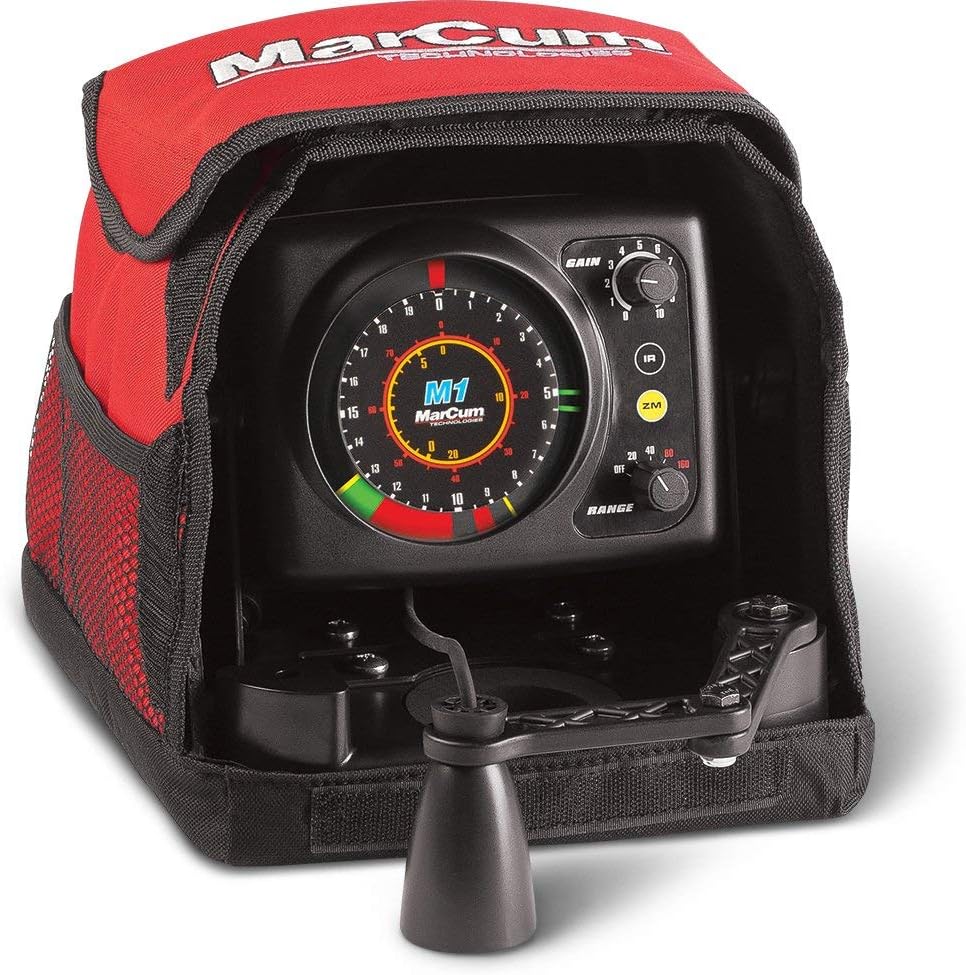
MarCum's tech specs list 1,000 watts peak-to-peak, 2 inch target separation, 6-step interference rejection and depth ranges of 20, 40, 80 and 160 feet. The manual adds 200 kHz, 250 mA current draw, a 10.5 to 15 volt operating range and 20° for all transducers. No run time is published.
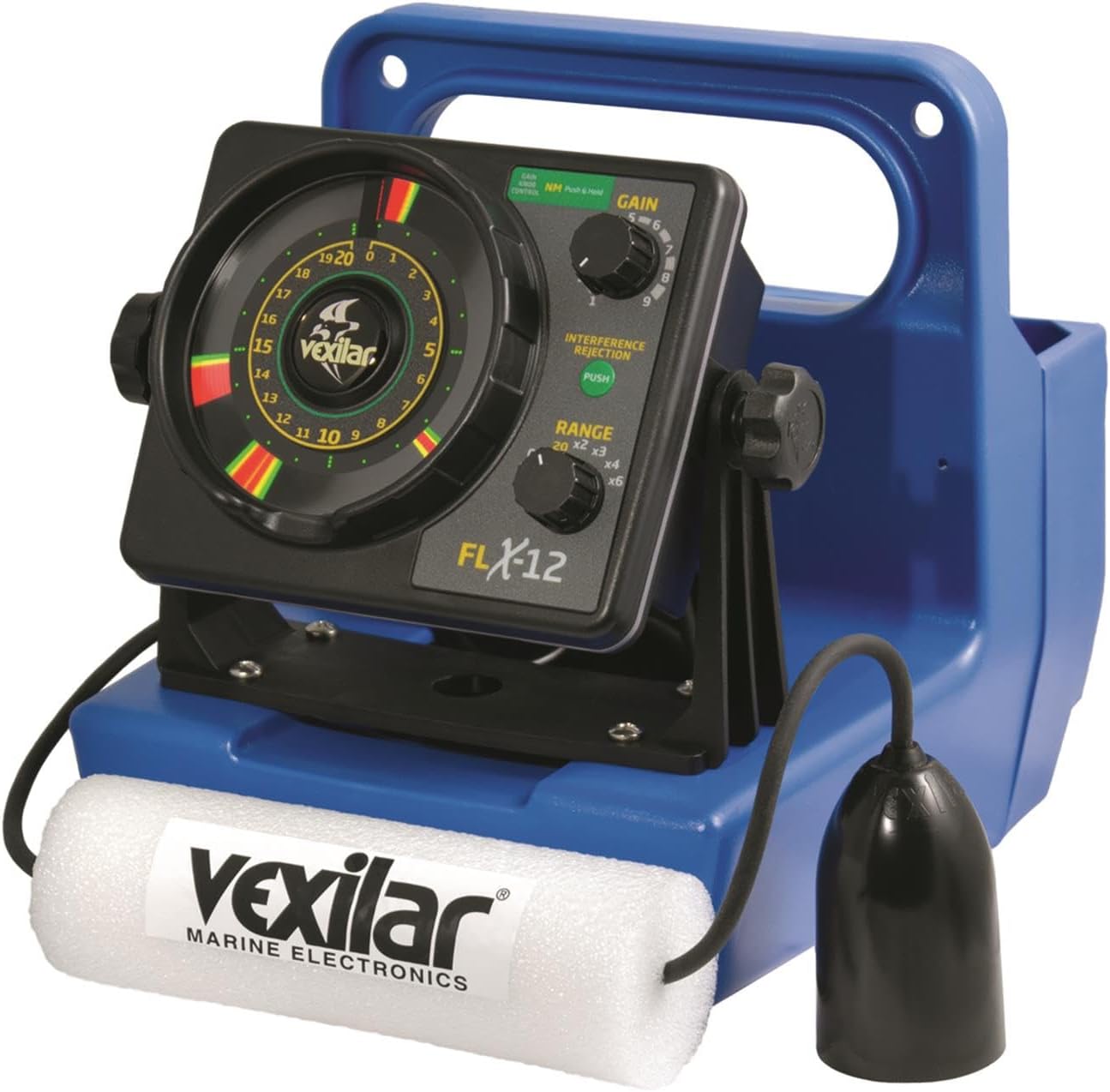
Vexilar lists 200 kHz, 1,000 watts peak-to-peak, 20 interference rejection settings, five depth ranges to 120 feet, a low-power mode for shallow water and a night mode. Ships with a 1 amp charger. No run time is published.
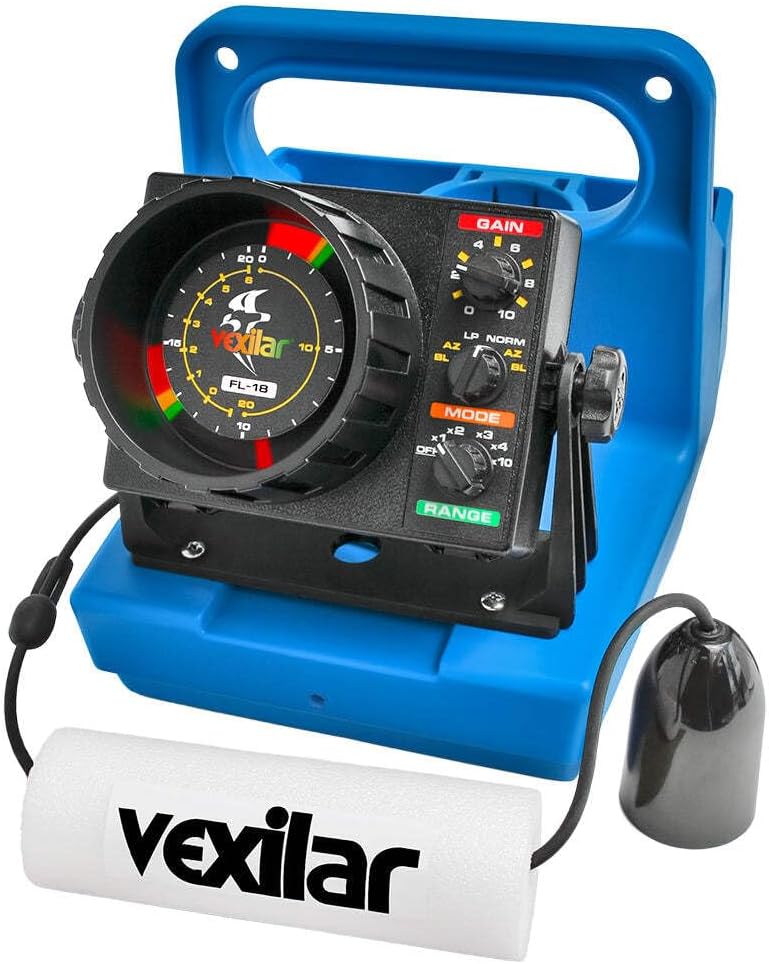
The FL-18 no longer has a page on vexilar.com. The 12° cone is named in the Amazon listing title and matches Vexilar's own 12° Ice-Ducer, and Vexilar's Genz Pack text names the FL-18 among the units it ships with a 12 volt, 9 amp-hour battery. Power, draw and run time are not published anywhere we could find from Vexilar.
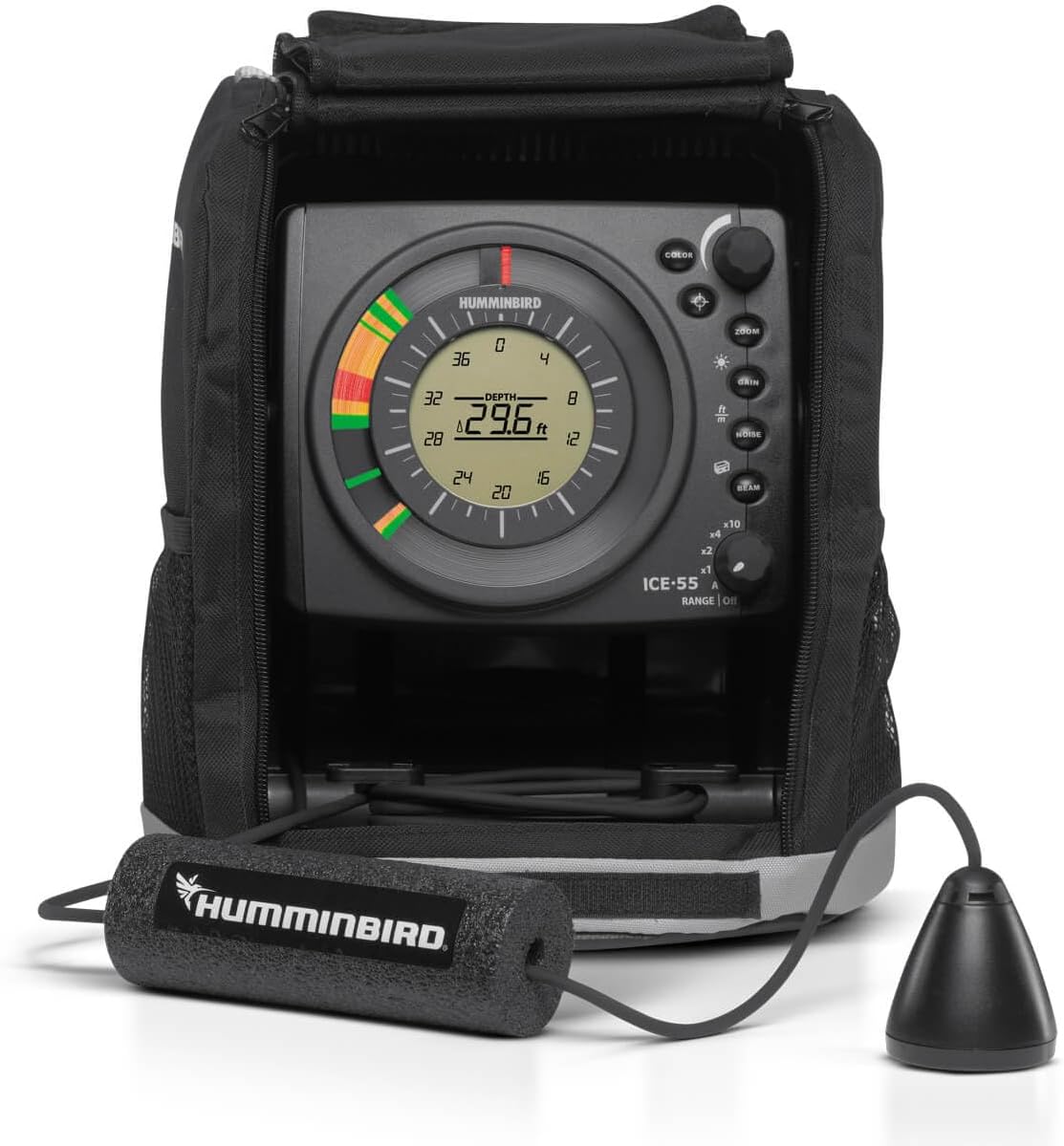
Humminbird's help article says the ICE series ships with the XI 9 19 ice transducer, with a 240 kHz beam covering about a third of the water depth and a 455 kHz beam covering about a sixth. It does not print the cone in degrees. The ICE 55 comes with a 9 amp-hour battery and charger. Target separation is 2 inches in zoom and 2.5 in normal mode. No run time is published.
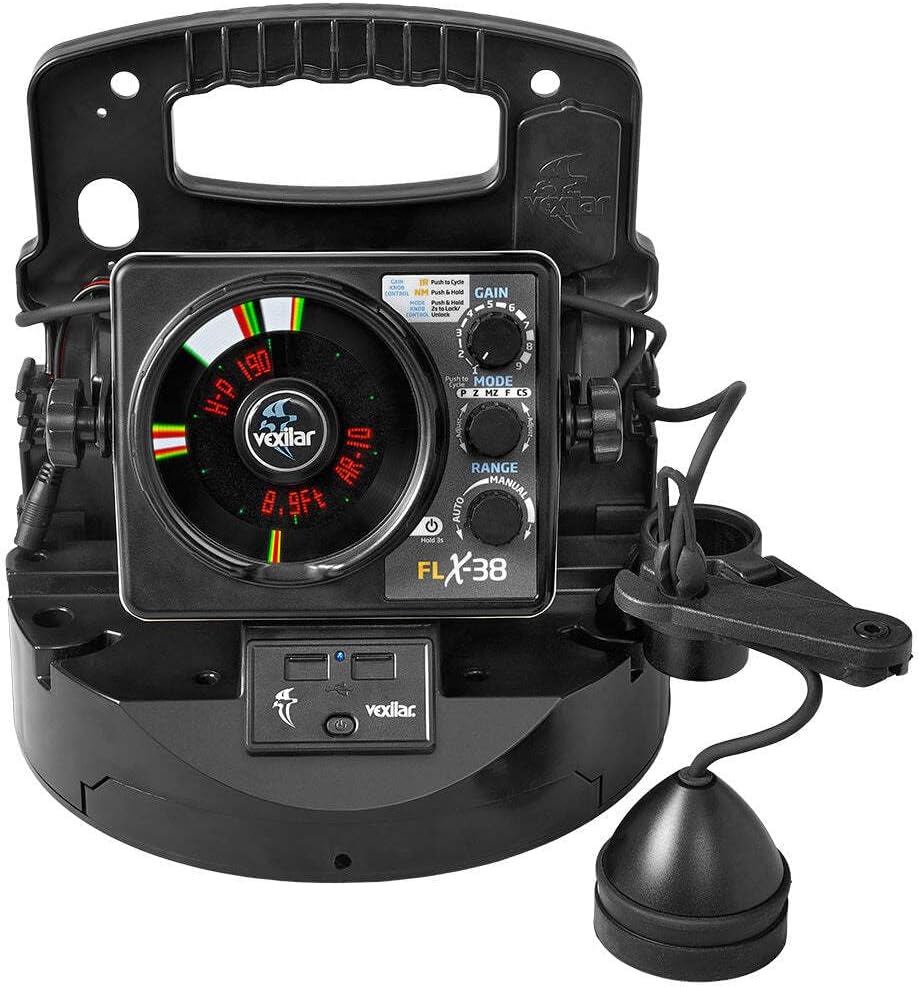
Fifteen selectable frequencies from 160 to 300 kHz. Vexilar's manual says the 160 kHz setting transmits a 15° cone and 300 kHz about 8°. The product page lists seven power levels, an adjustable zoom window from 6 to 18 feet, 300 interference rejection options, and a 12 volt, 9 amp-hour Vexilar lithium battery with a 1 amp lithium charger. No run time is published.
Short on time? Start with these top-rated ice fishing flashers picks.

Vexilar FL-8se Genz Pack (19° Ice-Ducer) is the #1 pick here, on 4.6-star Amazon buyer ratings (144 of them) and one clear job: a wide 19° cone for shallow water.
Check Price
MarCum M1 Flasher System (20° Transducer) is the #2 pick here, on 4.4-star Amazon buyer ratings (88 of them) and one clear job: spotting fish off the edge of the hole.
Check Price
Vexilar FLX-12 Genz Pack (12° Ice-Ducer) is the #3 pick here, on 4.6-star Amazon buyer ratings (74 of them) and one clear job: a narrow cone with 20 rejection steps.
Check PriceDetailed picks with verdicts, strengths, tradeoffs, and the situations where each one makes the most sense.

Quick verdict: Vexilar FL-8se Genz Pack (19° Ice-Ducer) is the #1 pick here, on 4.6-star Amazon buyer ratings (144 of them) and one clear job: a wide 19° cone for shallow water.

Quick verdict: MarCum M1 Flasher System (20° Transducer) is the #2 pick here, on 4.4-star Amazon buyer ratings (88 of them) and one clear job: spotting fish off the edge of the hole.

Quick verdict: Vexilar FLX-12 Genz Pack (12° Ice-Ducer) is the #3 pick here, on 4.6-star Amazon buyer ratings (74 of them) and one clear job: a narrow cone with 20 rejection steps.

Quick verdict: Vexilar FL-18 Genz Pack (12° Ice-Ducer) is the #4 pick here, on 4.6-star Amazon buyer ratings (123 of them) and one clear job: deeper water on a narrow cone.

Quick verdict: Humminbird ICE 55 Flasher (Dual Beam XI 9 19 Transducer) is the #5 pick here, on 4.5-star Amazon buyer ratings (100 of them) and one clear job: a wide and a tight beam on one cable.

Quick verdict: Vexilar FLX-38 Pro Pack Elite (Broad Band Ice-Ducer, Lithium) is the #6 pick here, on 5-star Amazon buyer ratings (9 of them) and one clear job: tuning the cone to the depth.
The cone is the slice of water the transducer listens to. A 20° cone covers a circle on the bottom roughly a third as wide as the water is deep, so about 7 feet across in 20 feet of water; a 12° cone covers closer to 4. Wide shows fish moving in from the side, which matters in shallow panfish water. Narrow keeps the jig and the fish under the hole on screen in deeper water. Vexilar itself recommends its 19° Ice-Ducer for water around 15 feet or less.
The Vexilar and MarCum units run on 12 volt batteries, and Humminbird gives the ICE 55's battery as 9 amp hours without printing a voltage. What changes is capacity and weight. MarCum ships the M1 with a 7 Ah sealed lead-acid battery; Vexilar's Genz Packs carry a 12 V 9 Ah battery; Humminbird puts a 9 Ah battery in the ICE 55 box; and the FLX-38 Pro Pack Elite comes with a 9 Ah Vexilar lithium. None of the spec pages read for this guide publishes a run time, so treat any hours figure you see elsewhere as a seller's estimate.
Two flashers on nearby holes can paint each other's pulses as random flickers. Every maker that publishes a figure lists an interference rejection control: MarCum lists 6 steps on the M1, Vexilar 10 on the FL-8se and 20 on the FLX-12, and Vexilar's product page lists 300 options on the FLX-38. No maker publishes a safe spacing distance, so the practical advice is to start with your buddy's unit on and step through the settings until the clutter stops.
Wattage figures run from 400 watts peak-to-peak on the FL-8se to 1,000 on the M1 and FLX-12, and Humminbird quotes 2.5 inches of target separation in normal mode on the ICE series. The makers measure and quote these differently, and none publishes how its wattage translates into depth or clarity on the ice, so treat the figures as a way to compare specs on paper. The cone and the features you will actually use, like zoom and a low-power mode for shallow water, are easier to judge.
A wide cone shows bluegill and crappie sliding in from the edge of the hole before they reach your jig. The FL-8se and the M1 both ship with one.
A narrow cone keeps a small jig visible as a crisp line in deep water instead of losing it in a wide footprint of bottom. The FLX-12 and the FL-18 both pair with Vexilar's 12° Ice-Ducer.
Humminbird's XI 9 19 transducer gives the ICE 55 a narrow and a wide beam on one cable. The FLX-38 changes its cone with frequency, from 15° at 160 kHz to about 8° at 300 kHz, by Vexilar's own figures.
Five steps, in order. The first two are where most bad readings come from.
Skim out the slush and ice chips. Floating debris scatters the signal and shows up as noise near the top of the dial.
Set the float and stopper so the face sits level, just under the water. A transducer resting on the ice edge or hanging at an angle reads off to the side.
Choose the range just deeper than the water you are in, so the bottom shows as a solid band on the dial instead of wrapping around it.
Start with gain low and bring it up until you see your jig as a thin line. Too much gain fills the dial with clutter, which MarCum's manual warns about directly.
If you see random flickers or a slow rotating mark, a nearby unit is the likely cause. Step through the rejection settings until it clears, and agree with your group that one person adjusts at a time.
Once you know which kit type fits your situation, dig into each gear category for in-depth picks and buying advice:
Want to browse beyond the ranked picks? Filter and sort the full ice fishing flashers listing below.


A flasher shows sonar returns as light on a spinning dial, in real time, with no scrolling history. A fish finder draws a scrolling chart on an LCD screen. Through the ice you are sitting still over one hole, so the history a fish finder records is mostly a flat line, while a flasher shows the instant your jig moves and a fish rises to it. Several ice units, including Humminbird's ICE HELIX and MarCum's LX series, put a flasher-style dial on an LCD, which is a different, pricier category this page does not rank. For boat fishing in open water, see the fish finder guides instead.
Neither, until you say how deep you fish. A wider cone covers more bottom, so it shows fish approaching from the side, which helps in shallow water. In deep water that same wide cone covers a big circle of bottom and a small jig can get lost in the clutter, which is where a narrow cone earns its keep. Vexilar recommends its 19° Ice-Ducer for water around 15 feet or less. If you fish both, a dual-beam transducer like Humminbird's XI 9 19 or the FLX-38's variable broad band cone covers both.
None of the makers' spec pages read for this guide publish a run time, so be cautious with anyone who quotes one. What they do publish is capacity and, for some units, current draw: MarCum lists 250 mA for the M1 on a 7 Ah battery, and Vexilar lists 200 mA at 12 V for the FL-8se and FLX-12 on a 9 Ah battery. Cold and age both reduce what a battery can deliver, so any run time you plan around should leave margin. MarCum's manual is blunt about the habit that matters most: recharge after every trip.
No maker on this page publishes a distance, and the answer moves with power settings, frequency and depth. Every maker that publishes a full spec here lists an interference rejection control instead. MarCum's manual recommends that only one person in a group adjust it at a time. In practice, turn your unit on, have the people nearby turn theirs on, and step through your rejection setting until the stray flickers stop.
MarCum's M1 manual says the unit can run off any 12 volt battery, and lists 10.5 to 15 volts as the operating range. The practical limits are the connector, the case and the charger. Each pack is built around a battery of a certain size, and a lithium battery needs a charger made for lithium. The FLX-38 Pro Pack Elite ships with Vexilar's own lithium battery and a 1 amp lithium charger for that reason. If you swap chemistries, swap the charger too.
Amazon does not appear to sell these units itself, so each listing here is run by a third-party seller, and some ship through Amazon's warehouses. Availability and sellers change, so check who is selling the unit and read the return policy on the listing before you buy.
Reader-supported and free of paid placements. Every pick is ranked on published specs and Amazon buyer ratings, not on who pays us.
Each pick is compared on published specs, materials, design, and category fit across the major brands.
Rankings factor in how well each product matches common freshwater fishing needs, not just popularity.
Star ratings and review volume from Amazon buyers are factored in to reflect real-world satisfaction.
A pick earns its spot by delivering useful performance for the money, whether budget or premium.

A flasher is a second-season buy. If you have not been out yet, the beginner ice guide covers the rod, line, cleats and hand auger that get you through a first trip without a flasher.
See the beginner ice kit