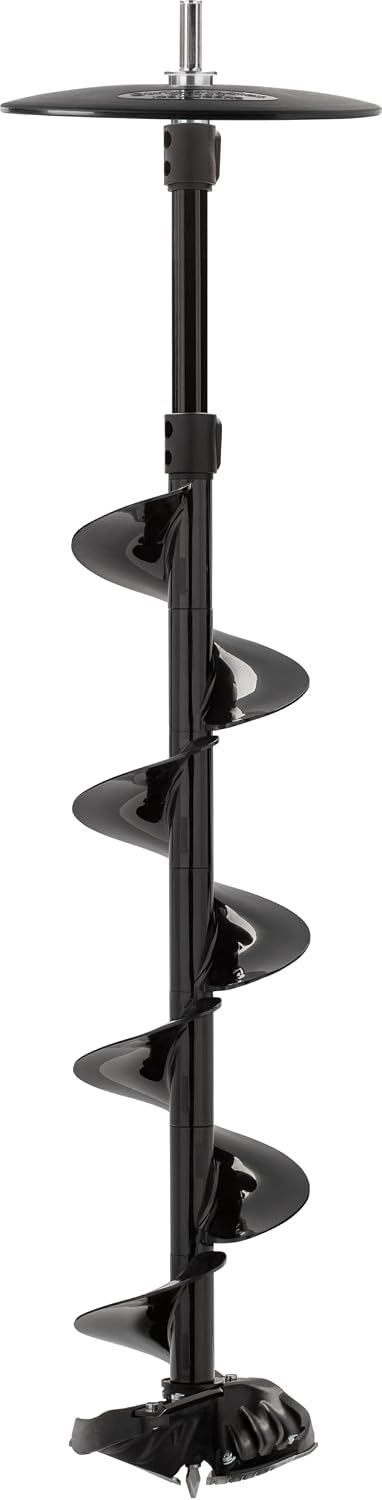
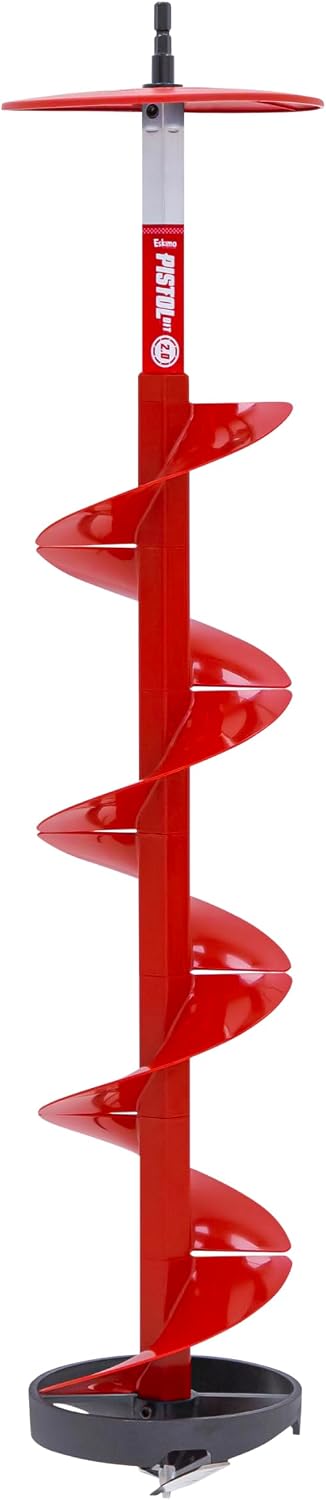
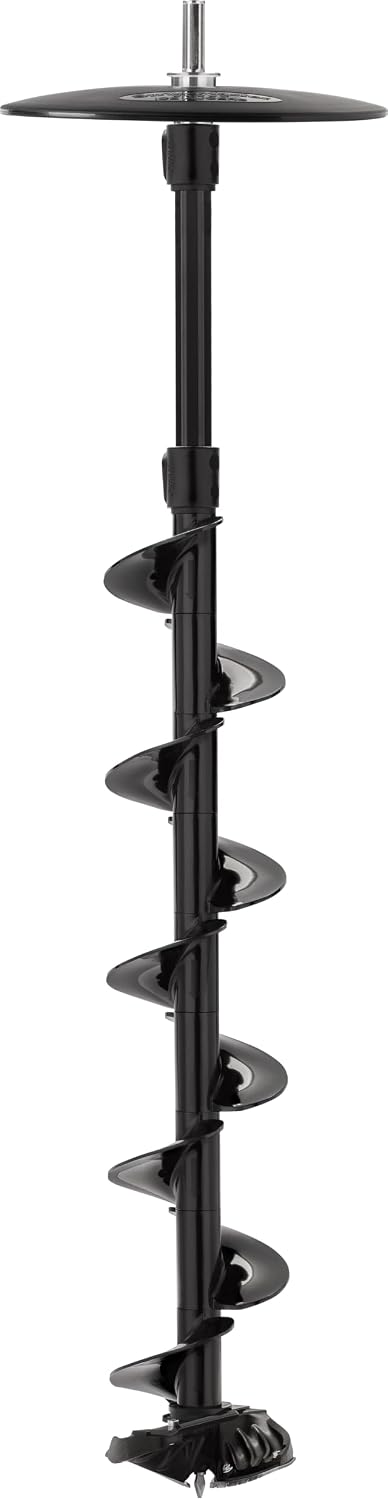
StrikeMaster Lite-Flite Lazer Drill Unit (8 in)
ASIN B07Y16LJ6ZStrikeMaster Lite-Flite Lazer Drill Unit (8 in) is the #1 pick here, on 4.8-star Amazon buyer ratings (244 of them) and one clear job: one auger that covers most fish.
Check Price
A drill auger is a bit and a top plate. The drill you bolt it to is the actual machine, and it is the part every other guide leaves out. Seven picks, each with the torque, chuck and battery its maker publishes.
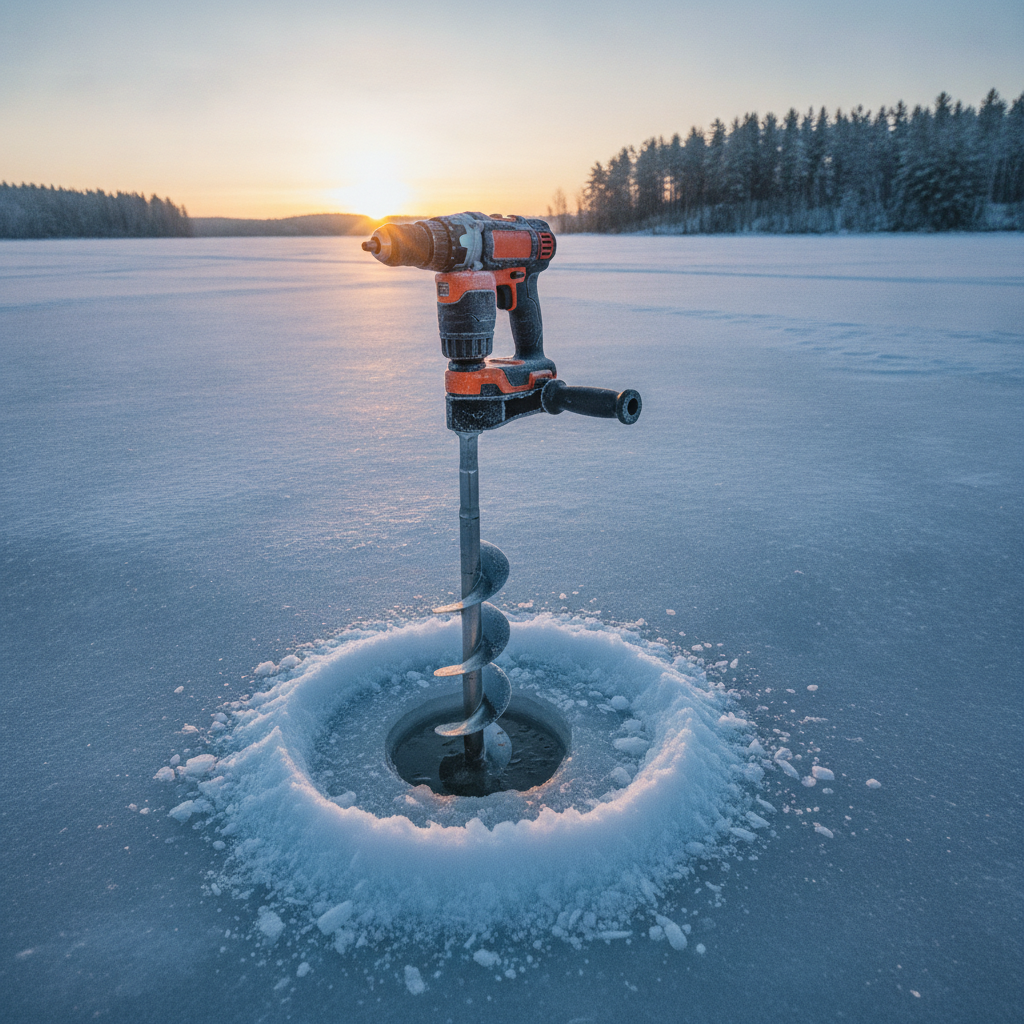
Start with the part the beginner guide already gets right: your first trip through the ice does not need a power auger. A sharp hand auger cuts six inches through a foot of ice in under a minute, costs a quarter of what any of this does, and never runs out of battery. If you have not been out yet, buy the rod and the cleats and go.
This page is for the season after that. You have decided you like it, you are cutting fifteen holes a day instead of three, and you have noticed that the guy hole hopping across the flat with a drill in his hand is fishing while you are still cranking. A drill auger is the cheapest way into power, because you are only buying the cutting half. The motor is the cordless drill in your garage.
Which is exactly where most buying guides stop being useful. They rank the bits and say nothing about the drill, and the drill is the part that decides whether this works. Every auger below is listed with the torque, chuck size, battery and handle its own manufacturer publishes as a minimum, and where a maker publishes nothing, this page says so rather than filling the gap with a number. Under-spec the drill and you get a bit that stalls halfway down and a tool that can twist hard enough to hurt your wrist.

A drill auger is half a tool. These are the other pieces, marked by whether you can start the season without them.
Brushless is in every published requirement list here, and it is not marketing. A brushed motor of the same voltage makes less torque and heats up faster under the sustained load of a full hole.
Every auger on this page specifies it. A three eighths chuck physically will not close on the shank, and the adapters that claim to bridge the gap put a wobble right where the load is.
Listed as a minimum requirement by both Eskimo and RAZR, not as an upgrade. It is what your second hand holds when the bit stops turning and the drill does not.
Eskimo's floor is 18V and 4 Ah for the 8 inch bits, 6 Ah for the 10 inch. RAZR asks 5 Ah for the Scout. Smaller packs will spin the bit and will not finish an afternoon.
Most bits ship with one. Carbide and tool steel edges chip on a truck bed or a sled rail, and a chipped blade cuts slowly and grabs, which is the thing you least want it to do.
The hole fills with slush the moment the bit comes out, and refreezes while you rig. A perforated scoop clears it in one pass. Cheap, and the item people most often leave in the truck.
Lithium cells give up capacity in the cold. A spare inside your jacket rather than in the sled is the difference between drilling at three in the afternoon and going home.
Worth having if you fish late ice or a lake that stacks up thick. Without one you can run out of shaft before you run out of ice, which is an awkward way to learn the lesson.
RAZR builds an easy-view safety flange into the Scout and K-Drill's listing says the bit floats. If yours does neither, a foam collar is cheaper than watching a bit go down the hole.
Every row below is copied from the manufacturer's own published requirements, checked in September 2026. Two makers publish a full specification and two publish only part of one. Where a figure is not published, this table says that rather than guessing, because a wrong torque minimum or a missing handle requirement is a safety problem and not a spec-sheet nicety.
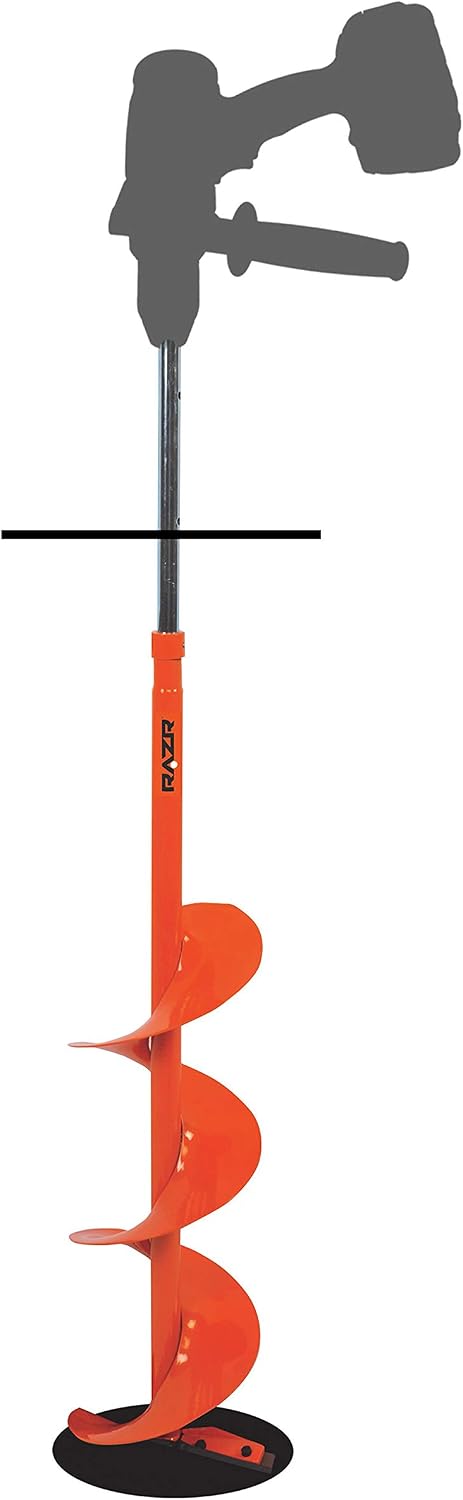
The fullest requirements list any of these makers publishes. RAZR asks for 550 rpm no-load on speed setting 1, a side stabilizer or handle, and the drill set to drill mode, stating plainly that you cannot run it in a screw or hammer mode. It names the Milwaukee 2804-20 and the DeWalt DCD999 as drills it pairs with. Source: RAZR's own Scout drill requirements post.
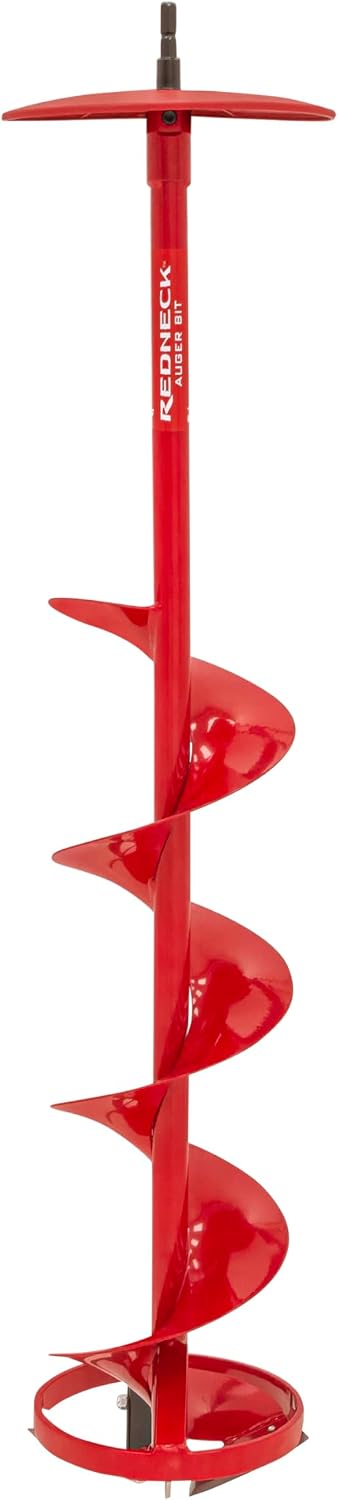
Eskimo's minimum list reads: side stabilizer arm, half inch drill chuck, 18 volt and 4 amp lithium-ion battery or higher, brushless motor, minimum 725 in-lbs of torque. The stabilizer arm is named first. No rpm, gear setting or drill mode is published. Weighs under 4 lb. Source: the product page on geteskimo.com.
Same torque floor as the 8 inch, but Eskimo raises the battery requirement to 6 amp hours for the bigger hole, which is a useful signal about where the extra diameter actually costs you. Weighs under 5 lb. Not ranked above; listed here because it is the size up from a pick. Source: geteskimo.com.
Identical published requirements to the composite Pistol Bit 2.0 in the same diameter, which is worth knowing: the steel bit is heavier to carry at 8.2 lb but does not ask more of the drill. Side stabilizer arm again listed as a minimum. Source: geteskimo.com.
StrikeMaster specifies any professional quality 18 volt or higher brushless hand-held electric half inch chuck cordless driver, or a StrikeMaster powerhead. That is the whole requirement: no torque minimum, no battery capacity, no rpm, no stabilizer requirement. Published weights are 4.4 lb for the 6 inch and 5.3 lb for the 8 inch. Source: rapala.com.
The thinnest published spec of the four. Vexilar describes the K-Drill as designed for modern high powered, brush-less hand-held cordless electric drills, and the Amazon listing adds that it fits standard half inch chuck electric drills and cuts ice up to 36 inches. No torque, battery, rpm, gear or handle figure is published on the manufacturer's site. Treat the Eskimo and RAZR numbers as a sensible floor.
Short on time? Start with these top-rated ice augers for cordless drills picks.

StrikeMaster Lite-Flite Lazer Drill Unit (8 in) is the #1 pick here, on 4.8-star Amazon buyer ratings (244 of them) and one clear job: one auger that covers most fish.
Check Price
K-Drill Ice Auger (7.5 in, IDRL75) is the #2 pick here, on 4.8-star Amazon buyer ratings (135 of them) and one clear job: deep, late-season ice.
Check Price
RAZR Scout Ice Auger (6 in) is the #3 pick here, on 4.6-star Amazon buyer ratings (107 of them) and one clear job: panfish holes on a smaller budget.
Check PriceDetailed picks with verdicts, strengths, tradeoffs, and the situations where each one makes the most sense.

Quick verdict: StrikeMaster Lite-Flite Lazer Drill Unit (8 in) is the #1 pick here, on 4.8-star Amazon buyer ratings (244 of them) and one clear job: one auger that covers most fish.

Quick verdict: K-Drill Ice Auger (7.5 in, IDRL75) is the #2 pick here, on 4.8-star Amazon buyer ratings (135 of them) and one clear job: deep, late-season ice.

Quick verdict: RAZR Scout Ice Auger (6 in) is the #3 pick here, on 4.6-star Amazon buyer ratings (107 of them) and one clear job: panfish holes on a smaller budget.

Quick verdict: Eskimo Redneck Bit Drill-Adaptive Ice Auger (8 in) is the #4 pick here, on 4.9-star Amazon buyer ratings (18 of them) and one clear job: hard use, and anglers who want steel.

Quick verdict: Eskimo Pistol Bit 2.0 Drill-Adaptive Auger (8 in) is the #5 pick here, on 4.4-star Amazon buyer ratings (13 of them) and one clear job: hole hopping all day on foot.

Quick verdict: StrikeMaster Lite-Flite Lazer Drill Unit (6 in) is the #6 pick here, on 4.4-star Amazon buyer ratings (48 of them) and one clear job: an 18v drill with less torque to spare.

Quick verdict: Mormysh Ice Auger Drill Adapter with Bearings (18 mm Shaft) is the #7 pick here, on 4.3-star Amazon buyer ratings (98 of them) and one clear job: powering a hand auger you already own.
Read your drill's torque figure before you read a single review. Eskimo publishes 725 in-lbs as the minimum for the Pistol Bit and the Redneck Bit; RAZR asks 750 in-lbs for the Scout. Both want an 18 volt or higher brushless motor and a half inch chuck. A ten year old brushed drill with a three eighths chuck will not hold the bit and will not turn it through a foot of ice, whatever the sticker on the battery says.
Eskimo lists a side stabilizer arm first in its minimum drill requirements, ahead of the chuck and the battery. RAZR lists a side stabilizer handle in the same block. The reason is simple: when the blades catch, the auger stops and the drill keeps trying to turn, and a one-handed grip is what that torque acts against. If your drill came with the side handle in the box and you threw it away, buy another before you buy an auger.
Six inches is plenty for panfish and most walleye, cuts fastest, and asks the least of a battery. Eight inches is what you want if a pike or a decent laker is realistic, and it is noticeably more work for the same drill. The gap shows up in battery life long before it shows up in speed. If your drill only just clears the published torque minimum, take the smaller hole.
Steel flighting shrugs off bouncing around a sled and cuts through refrozen slush without complaint. Eskimo's steel Redneck Bit weighs 8.2 lb in the 8 inch. The composite units are the ones you carry: the Pistol Bit 2.0 comes in under 4 lb in the same diameter, and StrikeMaster's Lite-Flite runs 4.4 lb at 6 inches and 5.3 lb at 8. If you walk out and hole hop, that difference is the whole point.
A 6 inch bit asks less of a marginal drill than an 8 inch one, every hole, all day. RAZR's Scout and StrikeMaster's 6 inch Lite-Flite both cut a hole big enough for anything most people catch through the ice.
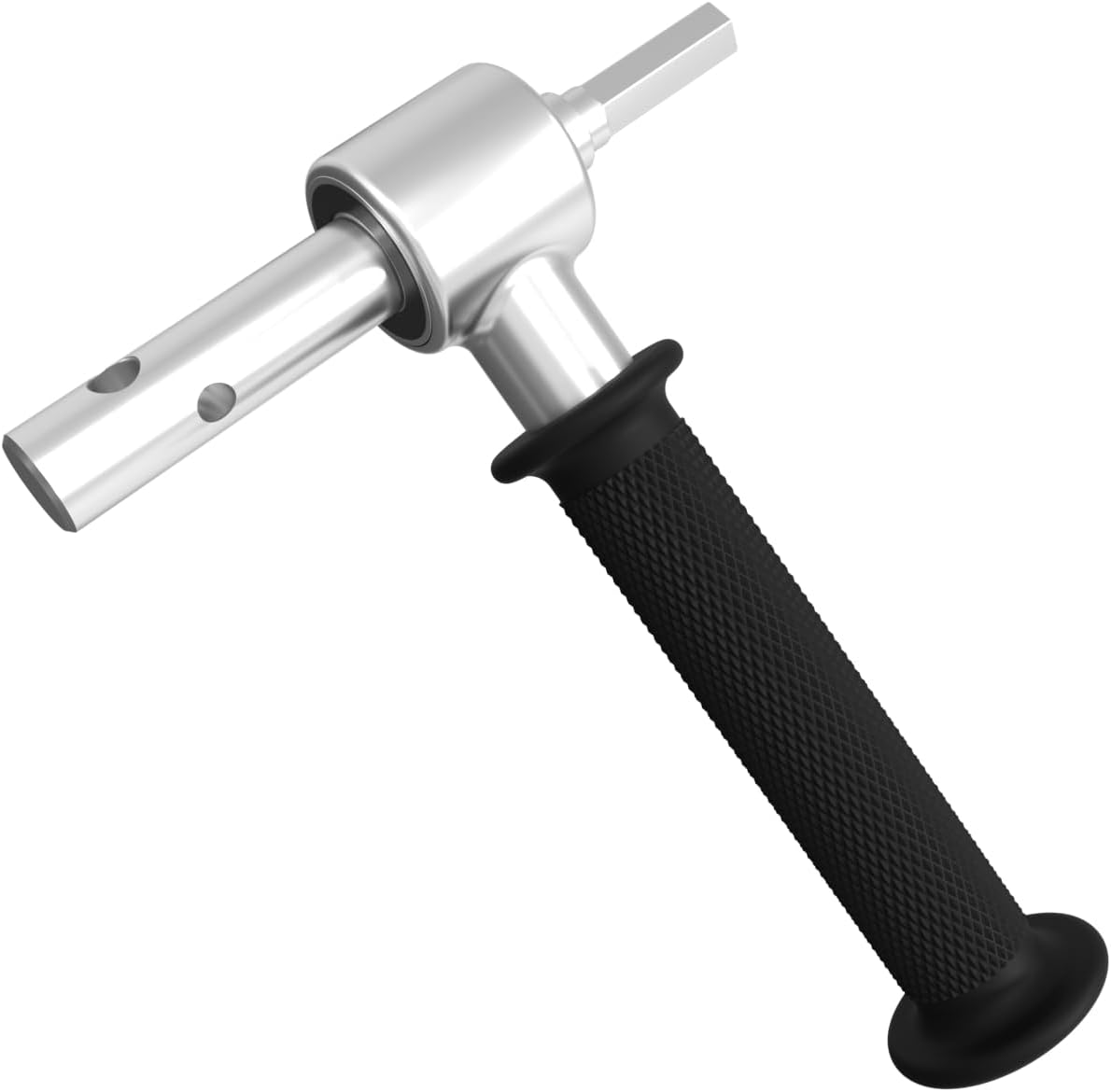
A 0.720 inch shaft adapter turns a StrikeMaster Mora or a Lazer into a drill auger for the price of a couple of jig packs. Measure the shaft before you order, because the adapter fits that diameter and nothing else.
Three feet of rotten March ice is where short bits run out of shaft and heavy bits run out of battery. K-Drill's listing rates the 7.5 inch for ice up to 36 inches, and the composite flighting keeps the weight down while it does it.
Five minutes in the garage, done once, saves a stalled bit and a wrenched wrist on the ice. The order matters.
It is on the spec sheet as in-lbs or Nm, not on the battery. Convert if you need to: 725 in-lbs is about 82 Nm, and 750 in-lbs is about 85 Nm. If your drill is under the number its maker publishes, the answer is a different drill or a smaller hole, not optimism.
Thread it onto the collar behind the chuck and set it roughly perpendicular to the grip, so your left hand is pushing down and resisting rotation at the same time. Tighten it properly. A handle that slips under load is worse than none, because you expected it to hold.
The clutch collar goes to the drill symbol, never the screw numbers and never the hammer. RAZR states this outright for the Scout. Then put the gear selector in 1, the low-speed high-torque setting, which is where RAZR's 550 rpm figure comes from.
Chuck the hex shank fully, tighten hard, then pull the bit to check it. A shank that creeps in a loose chuck rounds off, and a rounded shank never grips properly again.
The centering point goes in first and holds the bit where you put it. Keep the shaft vertical and let the blades feed themselves rather than leaning on the drill. Pushing does not cut faster; it loads the motor and packs the flighting with slush.
The last inch is where the bit suddenly drops and the auger tries to follow it. Slow down as you feel the resistance go, keep both hands on it, and let the flighting clear the hole before you lift.
Blade cover on, bit in the sled, spare battery in your jacket. Sharp edges are most of what makes this work and a truck bed is where they stop being sharp.
Once you know which kit type fits your situation, dig into each gear category for in-depth picks and buying advice:
Want to browse beyond the ranked picks? Filter and sort the full ice augers for cordless drills listing below.


Take the figure from the auger's own maker rather than from a forum. Eskimo publishes the same minimum for the Pistol Bit 2.0 and the Redneck Bit: a side stabilizer arm, a half inch drill chuck, an 18 volt lithium-ion battery of 4 amp hours or higher, a brushless motor, and a minimum of 725 in-lbs of torque. RAZR asks slightly more for the Scout at 750 in-lbs, a 5 amp hour battery minimum, and a no-load speed around 550 rpm on the low speed setting. StrikeMaster and Vexilar publish no torque figure at all for the Lite-Flite and the K-Drill, only that the drill should be 18 volt or higher, brushless, and have a half inch chuck. In-lbs is the number to look for on your drill's spec sheet, and it is not the same as the voltage.
Reader-supported and free of paid placements. Every pick is ranked on published specs and Amazon buyer ratings, not on who pays us.
Each pick is compared on published specs, materials, design, and category fit across the major brands.
Rankings factor in how well each product matches common freshwater fishing needs, not just popularity.
Star ratings and review volume from Amazon buyers are factored in to reflect real-world satisfaction.
A pick earns its spot by delivering useful performance for the money, whether budget or premium.

A power auger is the second thing you buy, not the first. If you have not been out yet, the beginner kit guide covers the rod, the line, the cleats and the hand auger that get you through a first trip for a fraction of this.
See the beginner ice kit